

Royal Weddings at Westminster Abbey — 2026 Visitor Guide
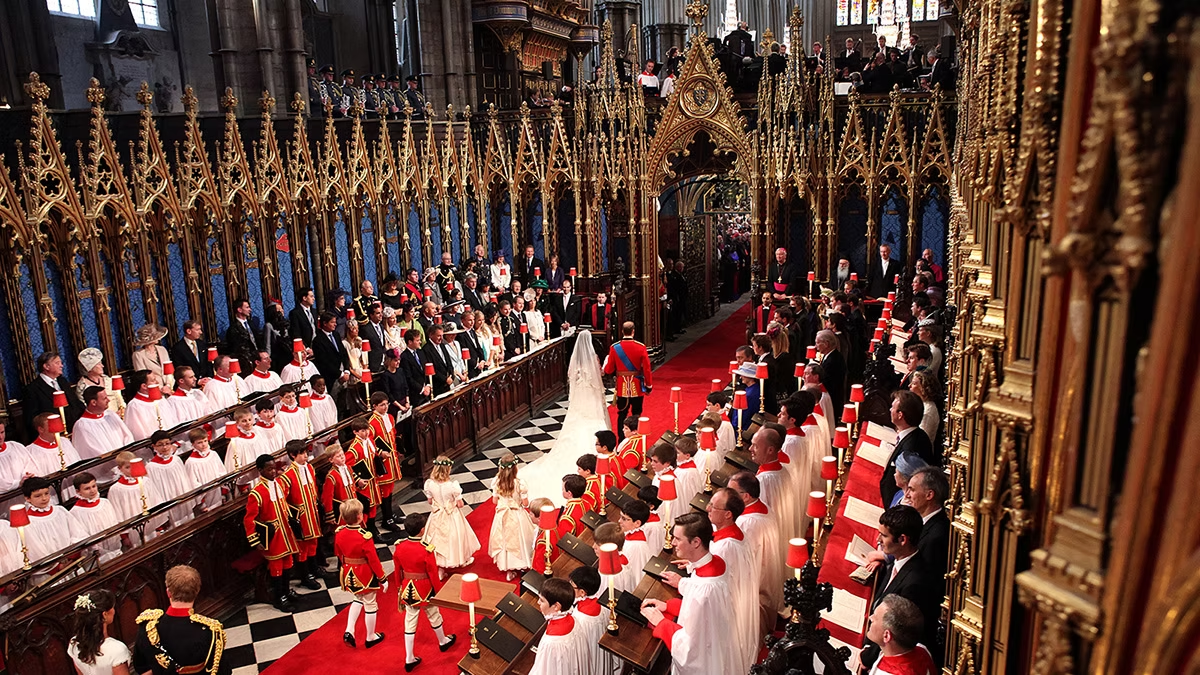
Westminster Abbey has hosted royal weddings for centuries, most famously the 2011 marriage of Prince William and Catherine Middleton, watched by an estimated 2 billion people worldwide, and the 1947 wedding of the future Queen Elizabeth II to Prince Philip. It is also the coronation church of England’s monarchs and the setting for state funerals, including that of Queen Elizabeth II in September 2022. When you visit, you walk the same nave and aisles used for these national occasions.
Few buildings anywhere are so woven into a nation’s public life as Westminster Abbey. It is where sovereigns are crowned, where royal couples marry, and where the country gathers to mourn its monarchs — often with the whole world watching by television and livestream. That triple role, coronation church, wedding church and funeral church, is what makes the Abbey feel less like a museum and more like the ceremonial heart of the United Kingdom.
This guide covers the royal weddings held here, the coronations and state funerals that share the same stage, and how the Abbey continues to serve national life in 2026 — plus what you can actually see of these events when you visit.
Royal Occasions at a Glance
| Occasion | Who | Year |
|---|---|---|
| Royal wedding | Prince William & Catherine Middleton | 2011 |
| Royal wedding | Princess Elizabeth (future Queen) & Prince Philip | 1947 |
| Coronation | King Charles III | 2023 |
| State funeral | Queen Elizabeth II | 2022 |
Royal Weddings at Westminster Abbey
The best-known royal wedding at Westminster Abbey is that of Prince William and Catherine Middleton on 29 April 2011, watched by around 2 billion people globally. The Abbey also hosted the 1947 wedding of Princess Elizabeth, later Queen Elizabeth II, to Prince Philip, and earlier 20th-century royal marriages. Weddings take place in the medieval church before the high altar, framed by the Cosmati Pavement.
The 2011 marriage of Prince William, now the Prince of Wales, to Catherine Middleton is the wedding most visitors picture. The couple exchanged vows before the high altar, the nave lined with avenue-like maple and hornbeam trees brought in for the day, and the ceremony reached a global television audience estimated at around 2 billion. It cemented the Abbey’s modern reputation as the stage for the monarchy’s happiest public moments.
The Abbey’s wedding history runs deeper than one day, though. On 20 November 1947 the young Princess Elizabeth, five years before she became Queen, married Prince Philip here in a ceremony that lifted spirits in a country still rationing after the Second World War. Earlier in the century the future King George VI married Lady Elizabeth Bowes-Lyon at the Abbey in 1923, and Princess Margaret married Antony Armstrong-Jones here in 1960. Standing in the nave and its soaring architecture, it is easy to see why the setting has drawn royal couples for generations.
Coronations — the Abbey’s Founding Role
Westminster Abbey has been the coronation church of English and British monarchs since 1066, hosting around 40 coronations. The most recent was the coronation of King Charles III on 6 May 2023. Every coronation uses the Coronation Chair, made around 1300, which sits in the Abbey and can be seen on a normal visit.
Weddings share the Abbey with its oldest ceremonial duty: crowning the sovereign. Since William the Conqueror was crowned here on Christmas Day 1066, almost every English and British monarch has been crowned in this church, roughly 40 coronations in all. The service centers on the Coronation Chair, a medieval oak throne made around 1300 that has held monarchs for more than 700 years.
The coronation of King Charles III on 6 May 2023 was the first many living people had witnessed, following his mother’s in 1953. The chronological story of how the Abbey came to hold this role is told in full in our history of Westminster Abbey, while the range of records the church holds is gathered in our Westminster Abbey facts guide.
State Funerals and Memorials
Westminster Abbey hosts state and ceremonial funerals for monarchs and, occasionally, other national figures. The funeral of Queen Elizabeth II took place at the Abbey on 19 September 2022, watched by an estimated global audience in the billions. The Abbey is also the resting place of the Unknown Warrior, whose grave near the Great West Door honors the fallen of war.
If weddings and coronations are the Abbey’s joyful occasions, its funerals are the moments a nation grieves together. The state funeral of Queen Elizabeth II on 19 September 2022 was among the most-watched events in history, the same nave that had seen her wedding in 1947 now holding her coffin. It was a striking illustration of how one building frames a life from beginning to end.
The Abbey also keeps a quieter, permanent memorial to national sacrifice: the grave of the Unknown Warrior, an unidentified serviceman of the First World War buried in the nave floor in 1920 to represent all who died. It is the only grave in the Abbey that visitors are asked never to walk across, and remains a focus of remembrance.
The Abbey’s Role in National Life Today
Westminster Abbey is a “Royal Peculiar,” a church answering directly to the Sovereign rather than to a bishop, which is part of why it hosts these national events. Alongside the great set-pieces, it holds annual services that mark the life of the country, from Commonwealth Day to services of thanksgiving and remembrance. Many royal figures are also buried here, and you can trace them through our guides to the royal tombs and to who is buried in the Abbey.
Because it is an active church, the Abbey occasionally closes to sightseeing at short notice for these services and state occasions. If your visit is planned around a particular date, confirm on the official site (westminster-abbey.org) that the Abbey is open to visitors that day.
Can You See the Wedding Sites When You Visit?
Yes. A standard visit takes you down the same nave used as the processional route for royal weddings and into the heart of the church before the high altar, where the vows are exchanged, set against the medieval Cosmati Pavement. There is no separate “wedding exhibit,” but the spaces themselves are the attraction. To explore them at your own pace, an entrance ticket with the included multimedia guide is the usual choice, while a professional guided tour brings the ceremonial history to life with a live expert.
Frequently Asked Questions
Which royal weddings took place at Westminster Abbey?
The most famous is the 2011 wedding of Prince William and Catherine Middleton. The Abbey also hosted the 1947 marriage of the future Queen Elizabeth II to Prince Philip, the 1923 wedding of the future King George VI to Lady Elizabeth Bowes-Lyon, and Princess Margaret’s marriage to Antony Armstrong-Jones in 1960, among others. Royal marriages have been held here across many centuries.
Where were Prince William and Kate married?
Prince William and Catherine Middleton were married at Westminster Abbey on 29 April 2011. The ceremony took place before the high altar, with the nave temporarily lined with living trees, and was watched by an estimated 2 billion people around the world. It is the royal wedding most visitors have in mind when they tour the Abbey today.
Was Queen Elizabeth II married at Westminster Abbey?
Yes. On 20 November 1947, Princess Elizabeth, who became Queen Elizabeth II in 1952, married Prince Philip at Westminster Abbey. The wedding was a rare moment of celebration in post-war Britain. The same church later hosted her coronation in 1953 and her state funeral in 2022, so the Abbey framed the major public moments of her life.
Why are royal weddings held at Westminster Abbey?
The Abbey is a “Royal Peculiar,” a church under the direct jurisdiction of the Sovereign, and it has been the coronation church of the monarchy since 1066. That deep royal connection, along with its scale, history and central London location beside the Houses of Parliament, makes it the natural setting for the monarchy’s most significant weddings, coronations and funerals.
Was Prince Harry and Meghan’s wedding at Westminster Abbey?
No. Prince Harry and Meghan Markle married at St George’s Chapel, Windsor Castle, in 2018, not at Westminster Abbey. Windsor is often chosen for weddings that are royal but not those of a direct heir. Westminster Abbey has tended to host the weddings most closely tied to the line of succession, such as Prince William’s in 2011.
Where was Queen Elizabeth II’s funeral held?
The state funeral of Queen Elizabeth II was held at Westminster Abbey on 19 September 2022, before her committal at Windsor. It was one of the most-watched broadcasts in history. The Abbey has long been the setting for the funerals of monarchs and national figures, part of the same ceremonial role that makes it the coronation and royal-wedding church.
Can I visit the spot where royal weddings happened?
Yes. On a normal visit you walk the nave that serves as the wedding processional route and reach the area before the high altar where the ceremonies take place. There is no roped-off “wedding zone,” so you experience the actual spaces. Booking an entrance ticket or joining a guided tour lets you take in these areas along with the rest of the church.
Is the Abbey ever closed for royal events?
Yes. As a working church, Westminster Abbey closes to sightseeing at short notice for coronations, state funerals, royal weddings, and other national services. These closures can happen with little warning. If your trip depends on a specific date, check the official website close to your visit to confirm the Abbey is open to visitors rather than reserved for a ceremony.
Are royal weddings still held at Westminster Abbey?
The Abbey remains available for royal weddings and continues its full ceremonial role, most recently seen in the coronation of King Charles III in 2023. Whether a future royal wedding is held here depends on the couple and the occasion. What is certain is that the Abbey stays at the center of national life, hosting coronations, memorials and services of state.
