

Poets’ Corner at Westminster Abbey: Complete Guide 2026
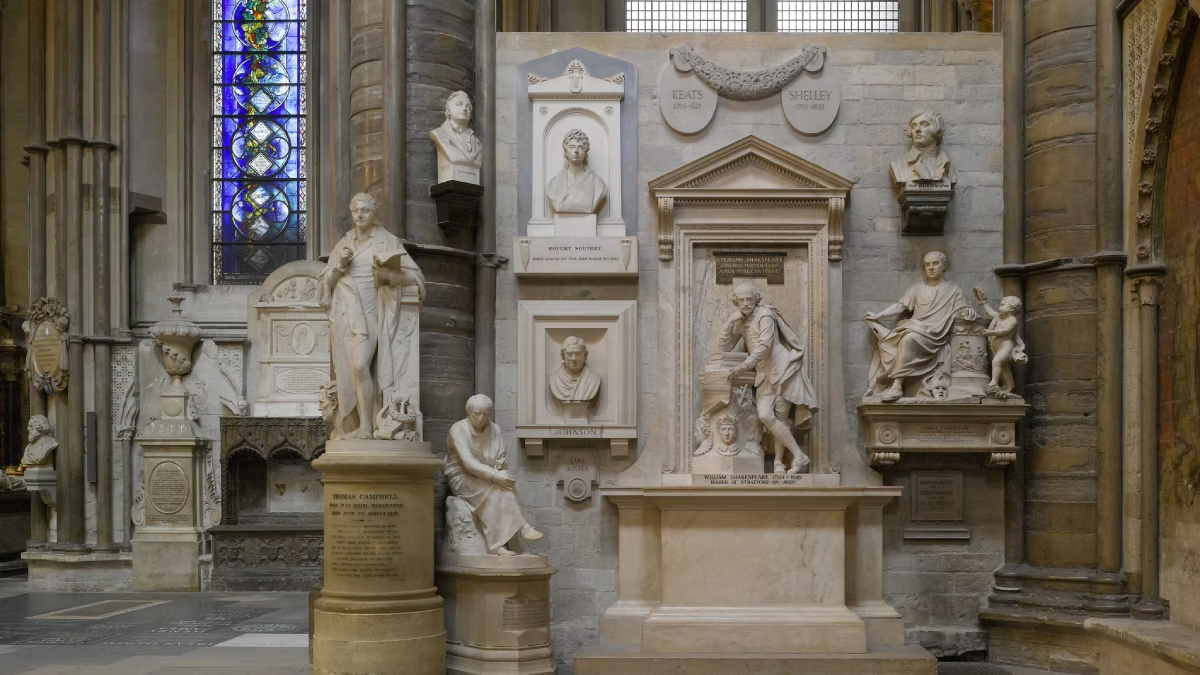
Poets’ Corner is the part of Westminster Abbey’s south transept where Britain’s great writers are buried or commemorated. The tradition began when Geoffrey Chaucer was buried here in 1400. Charles Dickens, Thomas Hardy, Rudyard Kipling and Alfred Lord Tennyson are among those buried; Shakespeare, Jane Austen and the Brontë sisters are honored with memorials rather than graves.
Of all the corners of Westminster Abbey, none is loved quite like Poets’ Corner. It’s a small area, easy to miss if you don’t know where to look, yet the floor and walls read like a roll call of English literature — some names marking actual graves, many more marking memorials to writers buried elsewhere.
This guide explains how Poets’ Corner came to be, who is buried there versus merely commemorated, the names to look for, and exactly where to find it on your visit.
How Poets’ Corner Began
Poets’ Corner began by accident. Geoffrey Chaucer, author of The Canterbury Tales, was buried in the south transept in 1400 — not for his poetry but because he had been Clerk of the King’s Works and lived nearby. When Edmund Spenser was buried close to him in 1599, the idea of a writers’ corner took hold, and it has drawn literary burials and memorials ever since.
The corner owes its existence to Geoffrey Chaucer, buried here in 1400. At the time he was honored as a royal official rather than as a poet, and he happened to be laid to rest in the south transept. Nearly two centuries later, when the poet Edmund Spenser was buried nearby in 1599, other writers reportedly threw poems and pens into his grave, and the notion of a dedicated literary corner was born. From then on, being buried or memorialized here became one of the highest honors in British cultural life.
Who Is Actually Buried There
Around 30 writers are buried in Poets’ Corner, including Geoffrey Chaucer, Edmund Spenser, Charles Dickens, Alfred Lord Tennyson, Robert Browning, Thomas Hardy and Rudyard Kipling. Being buried here is rarer than being memorialized — many of the plaques and statues honor writers whose graves lie elsewhere in Britain or abroad.
The list of writers genuinely buried in Poets’ Corner is shorter than most visitors assume. Chaucer and Spenser started it; later came Dickens, who was buried here in 1870 against his own wish for a quiet country grave. Tennyson, Browning, Hardy and Kipling are also buried here — though in Hardy’s case only his ashes are, as his heart was buried in Dorset. The actor David Garrick and composer George Frideric Handel lie here too, a reminder that “poets” is loosely defined.
Who Is Only Memorialized
Just as famous are the writers commemorated but not buried in Poets’ Corner. William Shakespeare has a fine memorial statue erected in 1740, more than a century after his death and burial in Stratford-upon-Avon. Jane Austen, the Brontë sisters, John Milton, William Blake, the Romantic poets Keats, Shelley and Byron, and more recently figures like C.S. Lewis and Philip Larkin are honored with plaques and windows rather than graves. Reading the memorials, it helps to remember the distinction — a name here doesn’t always mean a burial, a theme our guide to who is buried in the Abbey untangles across the whole church.
Names to Look For
The corner rewards slow looking, so keep an eye out for a few highlights as you go:
| Writer | Buried or memorialized | Note |
|---|---|---|
| Geoffrey Chaucer | Buried (1400) | The first, and the reason the corner exists |
| Charles Dickens | Buried (1870) | Buried here despite wanting a quiet grave |
| Thomas Hardy | Buried (ashes, 1928) | His heart is buried in Dorset |
| Rudyard Kipling | Buried (1936) | Author of The Jungle Book |
| Alfred Lord Tennyson | Buried (1892) | Victorian Poet Laureate |
| William Shakespeare | Memorial (1740) | Buried in Stratford-upon-Avon |
| Jane Austen | Memorial | Buried in Winchester Cathedral |
| The Brontë sisters | Memorial | Commemorated together |
How to Find Poets’ Corner
Poets’ Corner sits in the south transept, to your right as you face the High Altar, and you’ll reach it naturally on the Abbey’s one-way visitor route after the shrine and royal tombs. It’s one of the more crowded spots, so if you want space to read the inscriptions, aim for the quietest times — right at opening or later in the afternoon. Our guide to the full interior route shows how it fits with the other highlights, and the opening hours guide covers the calmest windows to visit.
Frequently Asked Questions
Where is Poets’ Corner in Westminster Abbey?
Poets’ Corner is in the south transept of the Abbey, on the right-hand side as you look toward the High Altar. You’ll pass it on the standard one-way visitor route, after the royal tombs and shrine area. It’s clearly signed and is one of the most visited parts of the church, so expect company — arriving early or late in the day gives you more room.
Who was the first person buried in Poets’ Corner?
Geoffrey Chaucer, author of The Canterbury Tales, was the first, buried in the south transept in 1400. He was honored at the time as a royal official rather than as a poet — he had been Clerk of the King’s Works. When Edmund Spenser was buried near him in 1599, the tradition of a writers’ corner took hold, and the area has drawn literary burials and memorials ever since.
Is Shakespeare buried in Poets’ Corner?
No. William Shakespeare is buried in Holy Trinity Church in Stratford-upon-Avon, his home town. Poets’ Corner has a memorial statue to him, erected in 1740 — well over a century after his death. It’s a common point of confusion, and a good example of the difference between the writers actually buried here and the many more who are only commemorated with memorials.
Is Charles Dickens buried in Westminster Abbey?
Yes. Charles Dickens was buried in Poets’ Corner in 1870, even though he had asked to be buried quietly near his home in Kent. Public feeling was so strong that he was laid to rest in the Abbey instead, with a deliberately plain grave. It remains one of the corner’s most-visited spots today.
What’s the difference between being buried and memorialized here?
Being buried means the writer’s remains actually lie in the Abbey; being memorialized means there’s a plaque, statue or window honoring them while their grave is elsewhere. Poets’ Corner has far more memorials than graves — Chaucer, Dickens and Hardy are buried here, while Shakespeare, Austen and the Brontës are commemorated. Our guide to who is buried in the Abbey explains the pattern across the whole building.
Which women writers are honored in Poets’ Corner?
Jane Austen and the Brontë sisters, Charlotte, Emily and Anne, are commemorated with memorials, as are more recent figures added over the years. For a long time the corner reflected the male-dominated literary canon, and campaigns have gradually added more women writers. None of these are burials — they are memorials — but they’re well worth seeking out among the older monuments.
Are writers still added to Poets’ Corner?
Yes, occasionally. New memorials are added from time to time by decision of the Dean of Westminster, though burials are now very rare. Twentieth-century additions include C.S. Lewis, Philip Larkin and others, showing the tradition is still alive. Each addition is a notable cultural event, and the corner continues to evolve rather than being fixed in the past.
Can I visit Poets’ Corner on a standard ticket?
Yes. Poets’ Corner is part of the main Abbey interior, so a standard entrance ticket covers it, along with the multimedia guide that explains its history as you go. No separate ticket is needed. If you’d like the stories behind the graves brought to life, a guided tour or a verger-led tour adds depth a self-guided visit can’t.
Is Poets’ Corner worth seeing?
For anyone with an interest in literature, it’s one of the Abbey’s most rewarding stops — few places on earth gather this many great writers in one small space. Even without a literary background, the sense of walking among centuries of famous names is memorable. Give yourself time to read the floor and walls rather than passing straight through.
