

Scientists’ Corner Westminster Abbey — Newton & Darwin
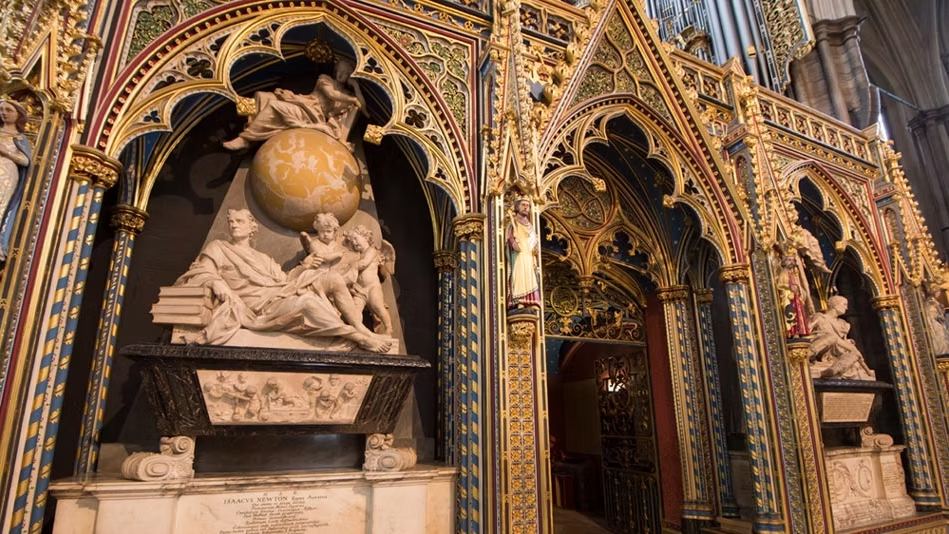
Scientists’ Corner is the area around the quire screen in the nave of Westminster Abbey where many of Britain’s greatest scientists are buried or memorialized. Isaac Newton’s grand monument stands here over his grave, Charles Darwin is buried a few feet away, and Stephen Hawking’s ashes were interred between them in 2018. It’s included in a standard Abbey entrance ticket.
Westminster Abbey is best known for kings, queens and poets, but it’s also one of the most important scientific burial grounds in the world. The cluster of graves and memorials near the entrance to the quire has come to be called Scientists’ Corner — a counterpart to the literary Poets’ Corner at the other end of the church.
The story starts with Isaac Newton in 1727 and runs right up to Stephen Hawking in 2018, taking in Darwin, Herschel, Rutherford, Kelvin and Faraday along the way. This guide explains who lies where, why the Abbey buries scientists at all, and how to find the corner on a visit.
Scientists’ Corner at a Glance
| Scientist | At the Abbey | Year |
|---|---|---|
| Isaac Newton | Buried, grand monument | 1727 |
| Charles Darwin | Buried near Newton | 1882 |
| Stephen Hawking | Ashes interred | 2018 |
| Ernest Rutherford | Buried | 1937 |
| Lord Kelvin | Buried | 1907 |
| Michael Faraday | Memorial (buried elsewhere) | 1867 |
Isaac Newton’s Monument and Grave
Isaac Newton was buried at Westminster Abbey in 1727 and given an elaborate monument on the north side of the quire screen. It shows him reclining, surrounded by figures and instruments representing his work in mathematics, optics and astronomy, with a globe above marking the comets and stars he studied. It was the first time a scientist was honored with such a prominent tomb in the Abbey.
Newton’s memorial anchors the whole corner. His burial in 1727 was a national event — Voltaire, then in London, remarked that England honored a mathematician the way other nations honored kings. The monument’s sculpted allegory of the sciences set a precedent, signaling that intellectual achievement could earn a place among the royalty and nobility elsewhere in the church. It’s one of the defining sights of the Abbey’s interior and the reason later scientists wanted to be laid to rest nearby.
Charles Darwin, Buried Beside Newton
Charles Darwin was buried at Westminster Abbey in 1882, only a few feet from Isaac Newton, despite the controversy his theory of evolution had caused. His grave is a plain stone slab in the floor of the nave, marked simply “Charles Robert Darwin.” The Abbey’s decision to bury him there was seen as science and the Church of England finding common ground.
Darwin had expected a quiet burial in his home village, but a campaign by scientists and members of Parliament secured him a place in the Abbey. The contrast between his understated floor slab and Newton’s towering monument is striking, yet the two lie almost side by side. Burying the author of “On the Origin of Species” in England’s coronation church was a deliberate statement about reconciling faith and reason — part of the wider story of who is buried at Westminster Abbey.
Stephen Hawking’s Ashes, Interred 2018
Stephen Hawking died in March 2018, and his ashes were interred at Westminster Abbey in June 2018, placed in the floor between the graves of Isaac Newton and Charles Darwin. His memorial stone carries his name, his dates, and his famous equation describing the entropy of a black hole. Placing him between Newton and Darwin linked three eras of British science in one spot.
The interment drew scientists from around the world and cemented Scientists’ Corner as a living tradition rather than a historical curiosity. Hawking’s stone is inscribed with the Bekenstein–Hawking equation for black-hole entropy, the kind of detail that rewards a close look at the floor. Standing on that single patch of pavement, you’re within a few feet of the men who defined gravity, evolution and modern cosmology — a concentration of scientific history that’s hard to match anywhere.
The Other Scientists Here
Scientists’ Corner is bigger than its three headline names. The physicist Ernest Rutherford, who split the atom, and Lord Kelvin, of the temperature scale, are both buried close to Newton. The astronomer Sir John Herschel lies nearby, and Michael Faraday, the pioneer of electromagnetism, has a memorial here although he was buried elsewhere at his own request. Together the memorials trace centuries of discovery, and reading the floor slabs and wall tablets is a quiet way to appreciate how the Abbey has honored science alongside the royal tombs and statesmen.
Finding Scientists’ Corner on a Visit
Scientists’ Corner sits at the entrance to the quire, in the nave, roughly midway along the church — so you pass through it early on the standard route, not at the far end. It’s covered by a normal entrance ticket, and the included multimedia guide flags the Newton and Hawking stones. Because the graves are set into the floor, they’re easy to walk over without noticing, so look down as well as up. If you want the scientific back-stories drawn out in person, a guided tour with a Royal Heritage guide covers this part of the nave in depth.
Frequently Asked Questions
What is Scientists’ Corner at Westminster Abbey?
Scientists’ Corner is the informal name for the part of the nave, near the quire screen, where many of Britain’s greatest scientists are buried or memorialized. It grew up around Isaac Newton’s 1727 monument and now includes Charles Darwin, Stephen Hawking, Ernest Rutherford, Lord Kelvin and others. It’s the scientific counterpart to Poets’ Corner and a highlight for anyone interested in the history of science.
Is Isaac Newton buried at Westminster Abbey?
Yes. Isaac Newton was buried at Westminster Abbey in 1727 and given an elaborate monument on the north side of the quire screen, showing him reclining amid symbols of his scientific work. His burial with such honor was unusual for a scientist at the time and set the pattern for the corner that followed. His grave is one of the most visited in the nave.
Is Charles Darwin buried at Westminster Abbey?
Yes. Charles Darwin was buried in the Abbey in 1882, a short distance from Newton, after a public campaign to honor him there. His grave is a plain stone slab in the nave floor inscribed simply with his name. Burying the author of the theory of evolution in England’s coronation church was a notable gesture of reconciliation between science and the Church.
Where are Stephen Hawking’s ashes?
Stephen Hawking’s ashes were interred at Westminster Abbey in June 2018, in the floor of the nave between the graves of Isaac Newton and Charles Darwin. His memorial stone bears his name, his dates and an equation describing black-hole entropy. Placing him between two giants of British science was a deliberate tribute to his standing in cosmology.
Which other scientists are at Westminster Abbey?
Alongside Newton, Darwin and Hawking, the area holds the graves of Ernest Rutherford and Lord Kelvin, the astronomer Sir John Herschel, and a memorial to Michael Faraday, who is buried elsewhere. The cluster spans physics, chemistry, astronomy and biology across several centuries, all gathered within a few steps of Newton’s monument.
Why does Westminster Abbey bury scientists?
The Abbey has long honored national figures beyond royalty, and Newton’s burial in 1727 established that scientists could be recognized there for their contribution to the country. Later burials of Darwin, Rutherford and Hawking continued the tradition, framing scientific achievement as part of Britain’s heritage. It reflects the Abbey’s role as a national church, not only a royal one.
Is Scientists’ Corner included in a Westminster Abbey ticket?
Yes. Scientists’ Corner is part of the main Abbey and included in a standard entrance ticket at no extra cost. It sits at the entrance to the quire, which you reach early on the visitor route. A guided tour adds context to the graves, but only the Jubilee Galleries and verger-led tours carry an additional charge; the memorials themselves are covered by general admission.
Where is Scientists’ Corner located in the Abbey?
It’s in the nave, around the screen at the entrance to the quire, roughly halfway along the church. Because the graves are set into the floor, they’re easy to miss if you’re looking up at the architecture, so watch the pavement for the Newton, Darwin and Hawking stones. It’s on the way to the royal tombs and the Lady Chapel further east.
How long should I spend at Scientists’ Corner?
Ten to fifteen minutes is enough to find the key stones and read the inscriptions, though anyone with a scientific interest may linger longer over the Hawking equation and the surrounding memorials. It’s an easy stop within a 1.5-to-2-hour Abbey visit and pairs naturally with the nearby monuments in the nave. Arriving early gives you a clearer floor to read.
