

Westminster Abbey Facts — What It’s Famous For (2026)
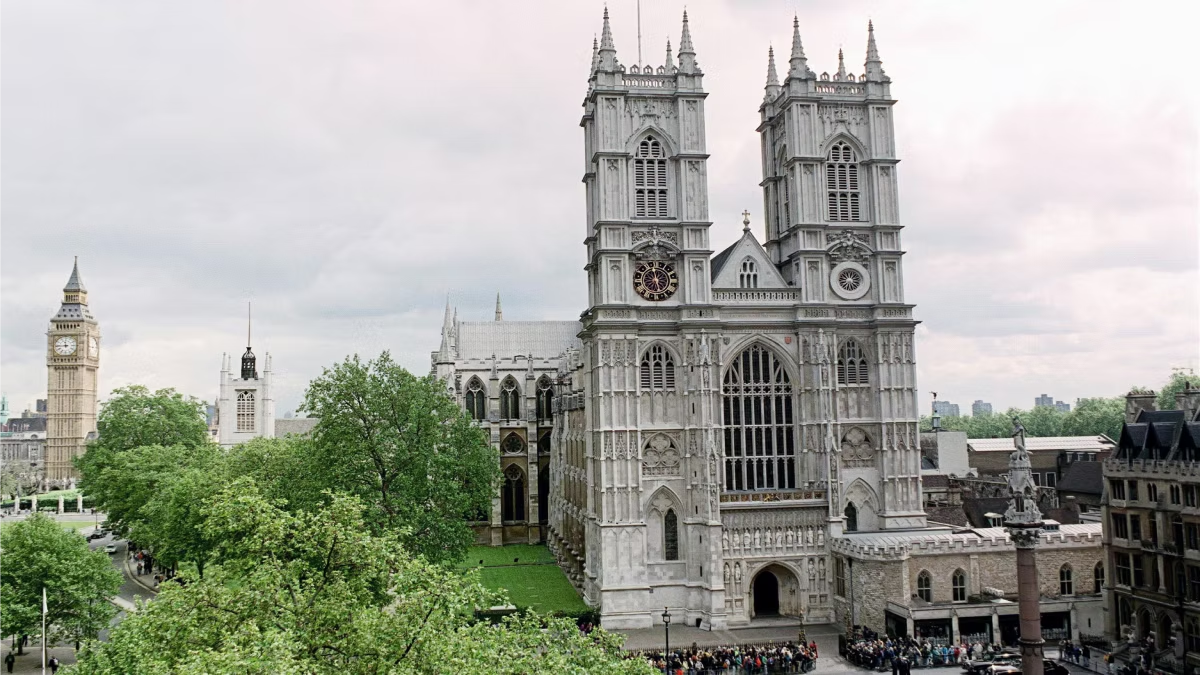
Westminster Abbey is famous as the coronation church of English and British monarchs since 1066, hosting around 40 coronations, most recently King Charles III in 2023. It is the burial place of some 3,300 people, including about 18 monarchs, and holds Poets’ Corner, Scientists’ Corner and the grave of the Unknown Warrior. It has been a UNESCO World Heritage Site since 1987, boasts England’s highest medieval vault, and is a “Royal Peculiar,” not a cathedral.
Some buildings are known for one thing. Westminster Abbey is famous for a whole cluster of them, coronations, royal tombs, poets, scientists, war remembrance, record-setting architecture, and its odd status as a church that is not a cathedral. This guide pulls those standout facts together in a quick, scannable form so you know exactly what makes the Abbey special before you go.
For the story of how the Abbey came to hold all these records, in chronological order, see our separate history of Westminster Abbey guide. Here, the focus is the highlights themselves.
Westminster Abbey Facts at a Glance
| Fact | Detail |
|---|---|
| Coronation church since | 1066 |
| Coronations held | Around 40 (latest: Charles III, 2023) |
| People buried or memorialized | Around 3,300 |
| Monarchs buried | Around 18 |
| UNESCO World Heritage Site | Since 1987 |
| Highest medieval vault in England | About 102 feet |
| Status | Royal Peculiar (not a cathedral) |
What Is Westminster Abbey Famous For?
Westminster Abbey is best known as the place English and British monarchs are crowned, a role it has held since 1066, with around 40 coronations. It is also famous for the many monarchs, poets, scientists and statesmen buried within it, for Poets’ Corner and the Unknown Warrior, and for its Gothic architecture. Together these make it one of the most historically significant churches in the world.
Above all, the Abbey is the coronation church of the monarchy. Every English and British sovereign since William the Conqueror in 1066 has, with very few exceptions, been crowned here, and the church remains the setting for the nation’s grandest ceremonies. That single role, sustained for nearly a thousand years, is the headline fact behind everything else.
Beyond coronations, the Abbey is famous for who lies within it and for the sheer density of history packed into one building. It draws visitors as a place of royal power, national memory and artistic tribute all at once.
The Coronation Church Since 1066
The Coronation Chair, made around 1300, has been used to crown monarchs for more than 700 years and can be seen on a normal visit; our guide to the Coronation Chair covers its story. Around 40 coronations have taken place here, the most recent being King Charles III on 6 May 2023. Few objects and few buildings anywhere have been so central to a country’s identity for so long.
Around 3,300 People Buried — Including 18 Monarchs
Around 3,300 people are buried or memorialized in Westminster Abbey, including roughly 18 monarchs, alongside statesmen, soldiers, poets, scientists and musicians. Kings and queens buried here range from Edward the Confessor to Elizabeth I and Mary I. It is one of the most concentrated collections of significant graves and monuments anywhere in the world.
The Abbey is effectively a national mausoleum. About 3,300 people are buried or commemorated within its walls, among them roughly 18 monarchs, from Edward the Confessor to the Tudor queens Elizabeth I and Mary I, who share a tomb. Statesmen, generals and cultural figures fill the rest, turning the building into a three-dimensional record of British history. You can trace the crowned heads through our royal tombs guide and the wider cast in our who is buried guide.
Poets’ Corner and Scientists’ Corner
Two of the Abbey’s most-loved corners honor genius rather than royalty. Poets’ Corner began with the burial of Geoffrey Chaucer and now commemorates writers from Charles Dickens to many of the country’s greatest poets and playwrights. Across the church, Scientists’ Corner gathers Isaac Newton and Charles Darwin, and in 2018 the ashes of Stephen Hawking were interred nearby, placing three of history’s greatest scientists close together.
The Grave of the Unknown Warrior
The grave of the Unknown Warrior holds an unidentified British serviceman of the First World War, buried in the nave floor in 1920 to represent all who died in the conflict. It is the only grave in Westminster Abbey that visitors are asked never to walk across. Set in black marble near the Great West Door, it remains a powerful focus of national remembrance.
Near the Great West Door lies one of the Abbey’s most moving features, the grave of the Unknown Warrior. Buried in 1920, this unidentified First World War soldier stands for all who fell without a known resting place. Uniquely, it is the one grave in the Abbey that no one is permitted to walk over, and it is often the point where visitors pause longest.
A UNESCO World Heritage Site Since 1987
Westminster Abbey has been part of a UNESCO World Heritage Site since 1987, inscribed together with the neighboring Palace of Westminster and St Margaret’s Church. The listing recognizes the outstanding value of this cluster of buildings to world history and architecture. It places the Abbey among a small group of globally protected landmarks.
England’s Highest Medieval Vault
An architectural record often surprises visitors: the Abbey has the highest medieval Gothic vault in England, rising about 102 feet above the floor. That soaring height, the work of Henry III’s 13th-century rebuild, is part of what gives the interior its breathtaking sense of scale. Our nave and architecture guide explains how the medieval builders achieved it.
Not a Cathedral — a “Royal Peculiar”
Despite its size and grandeur, Westminster Abbey is not a cathedral. It has no bishop and belongs to no diocese. Instead it is a “Royal Peculiar,” a church under the direct jurisdiction of the Sovereign. This unusual status is why it hosts coronations, royal weddings and state funerals, and it sets the Abbey apart from cathedrals such as St Paul’s.
One of the most common misconceptions is that Westminster Abbey is a cathedral. It is not. A cathedral is the seat of a bishop, and the Abbey has none; since Elizabeth I re-founded it in 1560 it has been a “Royal Peculiar,” answering directly to the monarch. This is also why it should not be confused with Westminster Cathedral, the separate Roman Catholic cathedral nearby.
A Church of Royal Weddings
The Abbey’s fame is not only about the past. It has hosted landmark royal weddings, including the 2011 marriage of Prince William and Catherine Middleton and the 1947 wedding of the future Queen Elizabeth II, and it staged the state funeral of Queen Elizabeth II in 2022. Our royal weddings and national occasions guide covers these events in detail. To see the settings for yourself, an entrance ticket with the included multimedia guide lets you explore at your own pace, while a guided tour adds expert context to the highlights.
Frequently Asked Questions
What is Westminster Abbey most famous for?
It is most famous as the coronation church of English and British monarchs, a role held since 1066, with around 40 coronations, most recently King Charles III in 2023. It is also renowned for the roughly 3,300 people buried or memorialized within it, for Poets’ Corner and Scientists’ Corner, and for the grave of the Unknown Warrior. Few buildings hold so much national history.
How many people are buried in Westminster Abbey?
Around 3,300 people are buried or commemorated in the Abbey, including roughly 18 monarchs along with statesmen, soldiers, poets, scientists and musicians. This makes it one of the densest concentrations of significant graves and memorials anywhere. Notable figures range from Edward the Confessor and Elizabeth I to Isaac Newton, Charles Darwin and Geoffrey Chaucer.
How many coronations have taken place at Westminster Abbey?
About 40 coronations have been held at Westminster Abbey since William the Conqueror was crowned here on Christmas Day 1066. The most recent was the coronation of King Charles III on 6 May 2023. Nearly every English and British monarch has been crowned in the Abbey, using the medieval Coronation Chair, which you can see on a normal visit.
Is Westminster Abbey a cathedral?
No. Westminster Abbey is not a cathedral, because it has no bishop and belongs to no diocese. It is a “Royal Peculiar,” a church under the direct jurisdiction of the Sovereign. This is different from Westminster Cathedral, which is the separate Roman Catholic cathedral located nearby. The two buildings are often confused but are entirely distinct.
When did Westminster Abbey become a UNESCO World Heritage Site?
Westminster Abbey was inscribed as part of a UNESCO World Heritage Site in 1987, together with the Palace of Westminster (the Houses of Parliament) and the nearby St Margaret’s Church. The listing recognizes the exceptional historical and architectural importance of this group of buildings. It places the Abbey among the world’s most protected cultural landmarks.
Who are the most famous people buried at Westminster Abbey?
Famous burials include monarchs such as Edward the Confessor, Elizabeth I and Mary I; scientists Isaac Newton and Charles Darwin, with Stephen Hawking’s ashes interred in 2018; and writers in Poets’ Corner, beginning with Geoffrey Chaucer and including Charles Dickens. Statesmen, composers and military leaders are also commemorated, making the Abbey a roll call of British achievement.
What architectural records does Westminster Abbey hold?
The Abbey has the highest medieval Gothic vault in England, rising about 102 feet, a feat of Henry III’s 13th-century rebuild. Its later features include the fan-vaulted Lady Chapel of the early 1500s and the western towers completed in the 1740s to Hawksmoor’s design. Together these span centuries of English architectural craftsmanship in a single building.
How are the facts different from the Abbey’s history?
This guide is a scannable collection of the Abbey’s standout facts and records, what it is famous for and its “did you know” highlights. If you would rather follow the story from monastery to modern church in order, our history of Westminster Abbey guide sets out the full chronological narrative. The two are designed to be read together.
Was Stephen Hawking really buried at Westminster Abbey?
Yes. The ashes of physicist Stephen Hawking were interred at Westminster Abbey in 2018, near the graves of Isaac Newton and Charles Darwin in the area often called Scientists’ Corner. Placing three of history’s most influential scientists close together is one of the Abbey’s more remarkable modern facts, and it draws many visitors to that part of the church.
