

Westminster Abbey History — Over 1,000 Years Explained
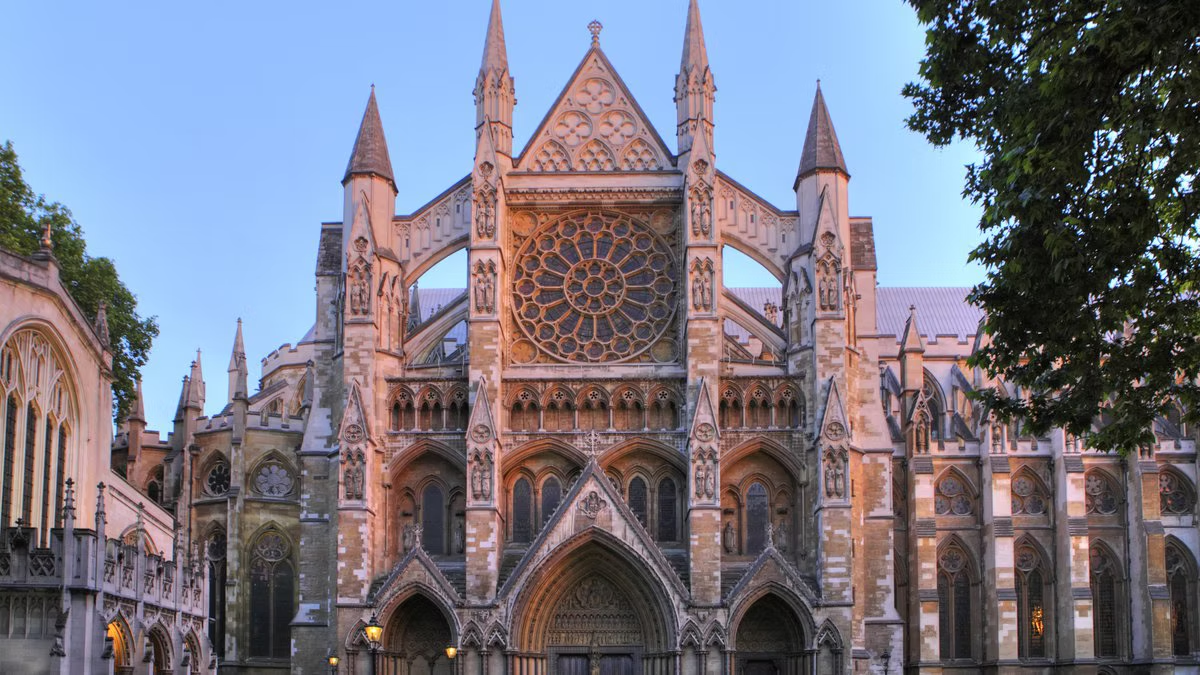
Westminster Abbey’s history stretches back more than 1,000 years. It began as a Benedictine monastery around the 960s, was rebuilt as a great church by Edward the Confessor and consecrated in 1065, then rebuilt again in the Gothic style by Henry III from 1245. It survived the Reformation as a “Royal Peculiar” under the Crown, gained its western towers in the 1740s, and remains a working church and coronation site today.
Westminster Abbey did not appear all at once. The building you visit is the product of more than a millennium of construction, destruction and reinvention, shaped by Anglo-Saxon monks, medieval kings, Tudor politics and Georgian architects. Reading it as a single story, rather than a checklist of highlights, is the best way to understand why it looks and feels the way it does.
This guide tells that story in order: the monastery’s foundation, Edward the Confessor’s church, Henry III’s Gothic rebuild, the upheaval of the Reformation, the Abbey’s unusual “Royal Peculiar” status, and the later additions that brought it to its present form.
Westminster Abbey Timeline at a Glance
| Period | What happened |
|---|---|
| c. 960s | Benedictine monastery founded under St Dunstan and King Edgar |
| 1065 | Edward the Confessor’s church consecrated |
| 1066 | First coronation here (William the Conqueror) |
| 1245 | Henry III begins the Gothic rebuild |
| 1503–1519 | Lady Chapel (Henry VII Chapel) built |
| 1540 | Monastery dissolved in the Reformation |
| 1740s | Western towers completed to Hawksmoor’s design |
A Benedictine Monastery (c. 960s)
Westminster Abbey began as a Benedictine monastery on Thorney Island, a site by the Thames west of the City of London, founded around the 960s under St Dunstan with the support of King Edgar. A small community of monks worshipped here for a century before Edward the Confessor transformed it into a great royal church. The monastic community shaped the Abbey for the next 600 years.
The Abbey’s earliest roots lie in a modest monastery established around the 960s, when St Dunstan, Archbishop of Canterbury, installed a community of Benedictine monks on Thorney Island, a patch of firmer ground amid the marshes of the Thames. King Edgar lent his support, and the “west minster,” the monastery church to the west of London, gave the site and eventually the whole district its name.
For roughly a century this was a quiet religious house rather than a national monument. That changed with the ambitions of a king who chose to build his own church, and to be buried in it.
Edward the Confessor’s Church (Consecrated 1065)
Edward the Confessor rebuilt the monastery as a large Romanesque church, consecrated on 28 December 1065, just days before his death. His new church made Westminster a royal burial and ceremonial site, and William the Conqueror chose it for his coronation on Christmas Day 1066. Almost nothing of Edward’s building survives above ground, but it set Westminster’s royal destiny.
Edward the Confessor, one of the last Anglo-Saxon kings, poured resources into rebuilding the monastery church on a grand Romanesque scale. It was consecrated on 28 December 1065, only a week before the king died; he was buried in his new church, beginning its role as a royal shrine. Within a year, the Abbey witnessed the coronation of William the Conqueror on Christmas Day 1066, launching a tradition that continues today.
Edward’s church has largely vanished, replaced by the later Gothic building, but its significance endured. His shrine still lies at the heart of the Abbey, and the tie between Westminster and the crowning of monarchs, explored further in our guide to royal weddings and national occasions, dates from this moment.
Henry III’s Gothic Rebuild (from 1245)
In 1245 King Henry III began replacing Edward the Confessor’s Romanesque church with the soaring Gothic building visitors see today, partly to honor Edward, whom he revered. Work continued for decades and gave the Abbey the highest medieval vault in England, at about 102 feet. The eastern parts, including the shrine and much of the church around it, date from this 13th-century campaign.
The Abbey’s present character is largely the work of Henry III, who from 1245 pulled down the older church and rebuilt it in the latest French-influenced Gothic style. Devoted to the memory of Edward the Confessor, whom he had canonized as a saint, Henry created a magnificent setting for Edward’s shrine and for royal ceremony. The result includes the tallest medieval vault in England, rising roughly 102 feet.
Construction of a building this ambitious took generations and continued in phases long after Henry’s death. The pointed arches, flying buttresses and vast windows you admire in the nave and its architecture belong to this long Gothic project, which defined the church for centuries.
The Lady Chapel and Late-Medieval Additions
Under the early Tudors the Abbey gained one of its greatest treasures. Between 1503 and 1519, Henry VII built a spectacular new Lady Chapel at the east end, its fan-vaulted ceiling among the finest achievements of English medieval craftsmanship. Intended as a burial place for Henry and his dynasty, it added a dazzling final flourish to the medieval church just as the religious world was about to be turned upside down.
The Reformation and Dissolution (1540)
During the Reformation, Henry VIII dissolved the monasteries, and Westminster Abbey’s Benedictine community was disbanded in 1540, ending nearly 600 years of monastic life. The Abbey briefly became a cathedral, then narrowly escaped destruction. In 1560 Elizabeth I re-founded it as a “Royal Peculiar,” a self-governing collegiate church answering directly to the Crown, the status it still holds today.
The Reformation nearly ended the Abbey’s story. When Henry VIII broke with Rome and dissolved England’s monasteries, the Benedictine community at Westminster was suppressed in 1540, closing a chapter that had lasted close to six centuries. For a short period the church was made a cathedral with its own bishop, sparing it the demolition that befell many monastic buildings.
The lasting settlement came under Elizabeth I. In 1560 she re-founded the Abbey as a collegiate church, the Collegiate Church of St Peter, governed by a Dean and Chapter and placed directly under the monarch. That decision preserved the building and defined its unusual constitutional position for the next four centuries.
A “Royal Peculiar,” Not a Cathedral
This is the point that most surprises visitors: Westminster Abbey is not a cathedral and has no bishop of its own. Since Elizabeth I’s re-founding it has been a “Royal Peculiar,” a church answering to the Sovereign rather than to a diocese. That independence is why the Abbey hosts coronations, royal weddings and state funerals, and it explains much about how the church operates today, a distinction we also cover in our Westminster Abbey facts guide.
Hawksmoor’s Towers and the Road to Today
The Abbey’s familiar western towers are far younger than the medieval church behind them. Left unfinished for centuries, they were completed in the 1740s to designs by Nicholas Hawksmoor, giving the west front the twin-towered silhouette recognized around the world. Later generations added monuments, memorials and restoration work, gradually filling the church with the tombs and statues seen throughout it.
Today Westminster Abbey remains a living church holding daily worship, alongside its role as coronation site and one of London’s most visited landmarks. To walk through it in person, an entrance ticket with the included multimedia guide lets you follow this thousand-year story at your own pace, while a guided tour adds an expert’s narration to the stones.
Frequently Asked Questions
How old is Westminster Abbey?
The site has held a church for more than 1,000 years. A Benedictine monastery was founded here around the 960s, and Edward the Confessor’s church was consecrated in 1065. The present building, however, largely dates from Henry III’s Gothic rebuild begun in 1245, with major additions such as the Lady Chapel (1503–1519) and the western towers (1740s) coming later.
Who founded Westminster Abbey?
A Benedictine monastery was founded on the site around the 960s under St Dunstan, Archbishop of Canterbury, with support from King Edgar. It was Edward the Confessor, though, who rebuilt it as a great royal church, consecrated in 1065, and Henry III who created the Gothic building we see today from 1245. Each of these figures shaped the Abbey we know.
When was Westminster Abbey built?
There is no single date, because the Abbey was built in phases. The consecration of Edward the Confessor’s church was in 1065, Henry III’s Gothic rebuild started in 1245, the Lady Chapel was added between 1503 and 1519, and the western towers were completed in the 1740s. The building you visit is a layering of work across more than seven centuries.
Why is Westminster Abbey not a cathedral?
Because it is a “Royal Peculiar,” a church under the direct authority of the Sovereign rather than a bishop. A cathedral is the seat of a bishop; Westminster Abbey has none. It briefly held cathedral status after the Reformation, but Elizabeth I re-founded it in 1560 as a self-governing collegiate church answering to the Crown, which is its status today.
What happened to Westminster Abbey during the Reformation?
The Benedictine monastery was dissolved in 1540 under Henry VIII, ending centuries of monastic life. The church avoided destruction by briefly becoming a cathedral, and in 1560 Elizabeth I re-established it as a collegiate church under royal control. This preserved the building and its treasures while much of England’s monastic heritage was lost.
Who is Edward the Confessor and why does he matter to the Abbey?
Edward the Confessor was an Anglo-Saxon king who rebuilt the monastery as a grand church, consecrated in 1065, and was buried there. Later canonized as a saint, he became the Abbey’s royal patron. Henry III’s 13th-century rebuild was undertaken partly in his honor, and his shrine still lies at the heart of the church.
How does the history differ from the Abbey’s list of famous facts?
This guide follows the story in chronological order, from monastery to modern church. If you want the standout records and highlights instead, such as the number of coronations and the famous people buried here, our Westminster Abbey facts guide gathers them in a scannable form. The two guides complement each other.
Can I still see the oldest parts of the Abbey?
Yes, though little of Edward the Confessor’s 11th-century church survives above ground. Most of what you see dates from Henry III’s Gothic rebuild onward, including the shrine area, the nave, the Lady Chapel and the Cloisters. A visit with the multimedia guide, or a guided tour, points out which parts belong to which period as you move through the building.
